
Maine BMV Permit Practice Test 11
- Questions30
- Correct to pass24
- Passing score80%
- Minimum age15 years
-
1. How long can cannabis affect a driver?
Show answer
Answer A: For hours after the strongest effects have passed
Slowed reactions, poor tracking and weak judgment of distance can last for hours, well beyond the point where the user believes the effects are over.
-
2. You wait in the aisle with your signal on for a space that is about to be vacated. What is the risk?
Show answer
Answer D: You block the aisle and drivers behind may try to squeeze past
A stopped vehicle turns a two-way aisle into a bottleneck, and drivers who try to get around it pass close to pedestrians and reversing cars.
-
3. You are traveling beside another vehicle on a multilane highway at nearly the same speed. Why is this a poor position?
Show answer
Answer B: You may be sitting in that driver's blind spot with nowhere to go if they move over
Driving alongside removes your side escape route and often puts you where the other driver cannot see you. Speed up or drop back to open space beside you.
-
4. How should you position your vehicle for a right turn from a two-way street?
Show answer
Answer B: As close as practical to the right curb or edge, then turn into the nearest right lane
Right turns are made from the lane nearest the right edge into the nearest available lane, which keeps the turn tight and prevents a wide sweep into other traffic.
-
5. What do two solid yellow lines down the middle of a two-way road mean?
Show answer
Answer D: Passing is prohibited for traffic in both directions
A double solid yellow line marks a two-direction no-passing zone, so neither direction may cross it to overtake another vehicle.
-
6. You are parking on a hill where there is no curb, whether facing up or down. Which way should the front wheels point?
Show answer
Answer B: Toward the shoulder, so the vehicle would roll away from the traffic lanes
With no curb to stop the vehicle, the wheels are turned toward the edge of the road so that a runaway vehicle leaves the roadway instead of entering it.
-
7. How should your speed behave while you move from one lane into the next?
Show answer
Answer C: Keep it steady or adjust it smoothly to match the traffic in the new lane
A lane change works best as a smooth movement at the speed of the lane you are joining, since sudden braking or acceleration surprises the drivers around you.
-
8. A flagger turns the paddle to the orange face reading SLOW. What does that tell approaching drivers?
Show answer
Answer D: Reduce speed and continue through the work area with care
The SLOW face keeps traffic moving at a reduced speed while workers or equipment are close to the travel lanes.
-
9. Traffic is heavy and a truck is stopped in the lane on your right. How do you keep an out?
Show answer
Answer B: Keep space open ahead of you and avoid being boxed in on both sides at once
Being hemmed in on both sides with no gap ahead removes every option, so keep at least one direction open.
-
10. Where in the United States may a motorcycle ride between lanes of traffic?
Show answer
Answer C: Only where a state has specifically authorized it
Riding between lanes is prohibited in most states and permitted only where a state law expressly allows it, so a rider must know the rule for the state being ridden in.
-
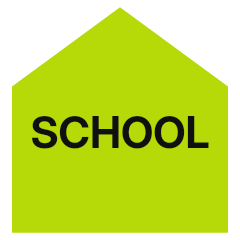
11. What must a driver be ready to do along the stretch of road where this sign is posted?
Show answer
Answer D: Slow down and stop for a child who steps into the roadway
Children misjudge speed and distance and act without warning, so the driver reduces speed, covers the brake and scans the sidewalks and parked vehicles.
-
12. Besides the traffic behind you, what else must you check before moving into the next lane?
Show answer
Answer D: That there is room ahead in the new lane for your normal following distance
Moving into a gap that is too short leaves you tailgating the vehicle ahead with a vehicle close behind you.
-
13. You are stopped at an intersection where bushes block your view of cross traffic. What should you do?
Show answer
Answer A: Edge forward slowly until you can see, then proceed when clear
Creeping forward a little at a time lets you gain a view without committing to the crossing. Never enter an intersection you cannot see into.
-
14. Should you drive with your hazard lights flashing while moving in fog?
Show answer
Answer A: No, they hide your turn signals and suggest you are stopped
Hazard lights on a moving vehicle tell other drivers you are stopped or disabled, and they cancel out your turn signals just when clarity matters most.
-
15. How much should you normally reduce your speed on a road covered with packed snow compared with dry conditions?
Show answer
Answer C: By about half
Packed snow roughly doubles the distance needed to stop, so a common guideline is to cut speed by about half. On ice, slow to a crawl.
-
16. What counts as a complete stop at a stop sign?
Show answer
Answer C: The wheels stop turning before the stop line
A legal stop means the vehicle is no longer moving, made at the stop line or before entering the crosswalk or intersection.
-
17. Your vehicle leaves the road and enters deep water. What gives you the best chance of escape?
Show answer
Answer B: Release your seat belt and get out through a window as quickly as possible
Water pressure holds the doors shut, so a window is the reliable exit and the first seconds after entry are the best time to use it.
-
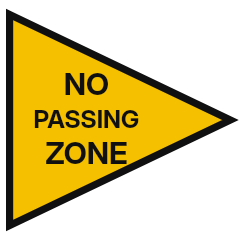
18. Why would a restriction like this one be applied to a stretch of road?
Show answer
Answer A: Because there is not enough visible road ahead to complete a pass safely
Limits on overtaking are set where a hill, a curve or an obstruction leaves too little sight distance for a driver to pull out, pass and return before meeting oncoming traffic.
-
19. In which situation should you increase your usual following distance?
Show answer
Answer B: On wet roads, at night, in fog, when towing a trailer, or when following a motorcycle
Reduced traction, reduced visibility, a heavier load and a vehicle that can stop faster than yours all require extra space to keep the same margin of safety.
-
20. After a crash, what information should you exchange with the other driver?
Show answer
Answer B: Name, address, driver license, vehicle registration and insurance details
Identification, registration and insurance information are what the other party and the insurers need. Sensitive financial details are never required.
-
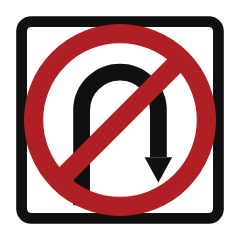
21. A driver who wants to reverse direction arrives at this sign. What is allowed?
Show answer
Answer C: Going on and reversing direction only where the maneuver is permitted
The restriction removes that maneuver at that spot entirely, so the driver has to continue and turn the vehicle around at a place where it is not prohibited.
-
22. Another driver takes a right of way that was legally yours. What should you do?
Show answer
Answer A: Give way to the other driver and avoid the crash, whatever the law says
Right of way is something you give, not something you take, and being in the right is no protection in a collision.
-
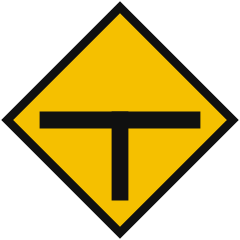
23. On which approach is this sign normally installed?
Show answer
Answer C: On the road that ends, far enough ahead for the driver to slow down
The warning belongs on the approach that terminates, placed early enough that the driver can lose speed and choose a direction before reaching the junction.
-
24. A bicyclist is riding in the middle of a narrow travel lane ahead of you. What is the correct response?
Show answer
Answer D: Slow down and wait until you can pass with wide clearance, changing lanes if needed
A bicyclist has the same right to use the lane as a driver, and a narrow lane may not leave safe passing room, so wait for a gap that lets you move over and pass with a wide margin.
-
25. You are in a minor collision on a busy road. No one is hurt and both vehicles can be driven. What is the recommended thing to do?
Show answer
Answer C: Move the vehicles out of the travel lanes to a safe spot before exchanging information
Vehicles left in traffic after a minor crash invite a second, often worse, collision. Clearing the lane protects everyone, and you still exchange details and report as required.
-
26. Two solid white lines are painted between your lane and the lane beside it. What do they mean?
Show answer
Answer D: Crossing from one lane to the other is prohibited
Double solid white lines separate lanes of traffic going the same way and may not be crossed.
-
27. Visibility drops suddenly and you decide to leave the highway. What is the safest way to do it?
Show answer
Answer A: Take the next exit or a wide pull off, well clear of the traffic lanes
Get right off the traveled way, and off the shoulder too if you can, because vehicles in poor visibility often drift onto the shoulder.
-
28. Is it acceptable to leave your vehicle across the entrance of an alley for a short time?
Show answer
Answer A: No, the entrance must stay clear at all times
Blocking an alley entrance traps the vehicles inside and can keep emergency services out, so it is prohibited however brief the stop.
-
29. What is sensible when you drive in an unfamiliar town for the first time?
Show answer
Answer C: Drive a little slower and give yourself more time to read the signs
In unfamiliar surroundings you need longer to take in signs, junctions and markings, and lower speed buys that time.
-
30. You are approaching a sharp curve. When should you reduce your speed?
Show answer
Answer D: Before you enter the curve, so you can accelerate gently through it
Braking hard inside a curve uses up the traction that is already being demanded for cornering, so the slowing must be finished before you enter.