
Maine BMV Permit Practice Test 18
- Questions30
- Correct to pass24
- Passing score80%
- Minimum age15 years
-
1. The road is icy and visibility is poor, but you are driving at the posted speed limit. Is this acceptable?
Show answer
Answer A: No, because you may never drive faster than is safe for the conditions
Under the basic speed rule a driver must travel at a speed that is reasonable for the actual conditions, so a legal posted speed can still be an unlawful and unsafe speed.
-
2. The hood of your vehicle flies open while you are driving and blocks your view. What should you do?
Show answer
Answer A: Look through the gap beneath the hood or out the side window, slow down and pull off the road
You usually still have a narrow view under the raised hood or through the side window. Use it to steer, slow gradually and get clear of traffic before securing the hood.
-
3. You have loaded the trunk heavily. Why might oncoming drivers flash their lights at you at night?
Show answer
Answer D: The rear sits lower, so your headlights point higher and dazzle them
Weight in the back tips the vehicle nose up and lifts the beam pattern, so low beams shine into the eyes of drivers coming the other way.
-
4. Two left-turn lanes are marked at the intersection and you are in the left one. What must you do?
Show answer
Answer A: Stay in your own lane all the way around the turn
With dual turn lanes each driver must hold a lane through the whole turn and come out in the matching lane of the new street.
-
5. What does a blood alcohol concentration of 0.08 mean for the driver of a car?
Show answer
Answer B: It is the level almost every state treats as legally intoxicated
In almost every state a driver at 0.08 or above is legally intoxicated whatever the driver seems like, but impairment starts well before that level is reached.
-
6. Why is a shoulder check especially important on a road with motorcycles and bicycles?
Show answer
Answer D: A narrow vehicle can disappear completely in the blind spot
A motorcycle or a bicycle is small enough to be hidden entirely by a door pillar or by the blind spot the mirrors do not cover.
-
7. A deer crosses the road in front of you and disappears into the trees. What should you expect?
Show answer
Answer B: That other deer are likely to follow it across the very same stretch of road
Deer usually move in groups, so one crossing the road is a warning that more may follow.
-
8. Which of these is part of preparing a vehicle for winter driving?
Show answer
Answer A: Fitting good tires and using washer fluid that will not freeze
Winter readiness means tread, battery, wipers, antifreeze and washer fluid rated for the cold, plus a reasonable amount of fuel in the tank.
-
9. How can you keep space at the sides of your vehicle in heavy traffic?
Show answer
Answer D: Drive in the gaps between the other vehicles rather than beside them
Travelling in the open spaces rather than alongside others keeps a way out open on at least one side.
-
10. You are circulating in a roundabout and a vehicle is waiting to enter ahead of you. What should you do?
Show answer
Answer D: Keep going, because circulating traffic does not stop for entering vehicles
Stopping in the circle to be polite surprises the drivers behind you and defeats the design; entering traffic is the side that waits.
-
11. A sign with a green background and a white legend normally provides
Show answer
Answer A: directions, distances and destinations
Green is the background color of the guide sign series, which names routes and destinations and gives the distance to them.
-
12. Cones and drums mark a shifted lane through a work zone. What should you do?
Show answer
Answer A: Follow the path that they mark and stay inside it
Channelizing devices define the temporary travel path, and the space on the other side of them belongs to the workers.
-
13. What does it mean to scan the road while driving?
Show answer
Answer A: Moving your eyes constantly over the road, the sides and the mirrors
Scanning keeps information coming in from every direction, while a fixed stare leaves you blind to everything else.
-
14. You are approaching a traffic light that has been green for a long time. How should you treat it?
Show answer
Answer C: Expect it to change and be ready to stop
A light that has been green for a while is called a stale green light. Cover the brake and decide in advance where you could still stop safely.
-
15. You reach a T intersection where the cross street has a ONE WAY sign pointing to the right. What may you do?
Show answer
Answer B: Turn right only, because the street carries traffic in that direction
The arrow shows the only direction traffic may travel, so the only legal movement from the terminating road is a right turn.
-
16. A steady green downward arrow is displayed above the lane you are in. What does it tell you?
Show answer
Answer A: You may drive in that lane
A green downward arrow means the lane beneath it is open for travel in your direction.
-
17. A train has just cleared a crossing that carries two sets of tracks. What should you do?
Show answer
Answer B: Wait and look both ways for a second train
A passing train hides a second train on the other track, so wait until the signals stop and you can see that both tracks are clear.
-
18. Where should your hands normally rest on the steering wheel?
Show answer
Answer C: On opposite sides of the wheel, near the 9 and 3 positions
Hands placed opposite each other near the middle of the wheel give smooth, balanced control and keep the arms clear of a deploying air bag.
-
19. Why are pedestrians and cyclists a special risk on unlit streets at night?
Show answer
Answer A: Dark clothing can make them invisible until they are very close
A person in dark clothing reflects almost no light and may not appear until they are inside your stopping distance, so cut your speed where people may be about.
-
20. You pass into a work zone with a reduced speed limit but you see no workers. What speed applies?
Show answer
Answer D: The posted work zone limit, whether or not workers are present
A posted work zone speed limit is a regulatory limit in force at all times, and narrow lanes and uneven surfaces remain dangerous when nobody is working.
-
21. Where should the lap part of the seat belt sit?
Show answer
Answer C: Low and snug across the hips, touching the tops of both of the thighs
The hip bones can take crash forces, but the abdomen cannot, so the lap belt goes low and tight across the hips.
-
22. How long should a glance at a mirror or an instrument take?
Show answer
Answer A: A brief glance of about a second, returning your eyes to the road at once
Checks should be quick flicks of the eyes. At highway speed, a few seconds with your eyes off the road covers a distance long enough for a hazard to appear.
-
23. A grade crossing is marked only with a crossbuck and has no lights or gates. What does the crossbuck require of you?
Show answer
Answer C: Yield to rail traffic and cross only when no train is approaching
The crossbuck requires road users to yield the right-of-way to rail traffic, so you must look and listen and be ready to stop.
-
24. About how far does a vehicle travel in one second at 60 mph?
Show answer
Answer A: About 88 feet
At 60 mph you cover about 88 feet every second, which is why a glance of only two or three seconds means driving the length of several vehicles blind.
-
25. Is it safe to check your phone while stopped at a red light?
Show answer
Answer B: No, you may miss the signal change and hazards around you
Attention does not return instantly when the light changes, and emergency vehicles, pedestrians or a rear-end threat can appear while you are stopped. Stay focused on the road.
-
26. You are turning left from a divided highway through a median opening into a business on the other side. Who has the right of way?
Show answer
Answer C: The traffic on the roadway you are crossing
Turning through a median opening means crossing the opposite roadway, so you yield to all traffic on it before you go.
-
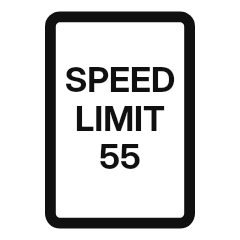
27. On a clear day with light traffic, a driver stays far below the maximum this sign sets. What can that cause?
Show answer
Answer B: Obstruction of the normal flow of traffic, which is prohibited in itself
Driving so slowly that other traffic is impeded is an offense in its own right when nothing about safety, weather or the road calls for it.
-
28. Why is the road often most slippery during the first few minutes of rain after a long dry spell?
Show answer
Answer C: Oil and dust on the surface mix with the water into a slick film
Oil drippings and road dust build up on dry pavement, and the first light rain lifts them into a slippery film before heavier rain washes it away.
-
29. What is the recommended minimum distance between the driver's breastbone and the center of the steering wheel air bag cover?
Show answer
Answer C: About 10 inches
An air bag inflates extremely fast, and keeping that much space lets it deploy fully before it reaches the driver, which is why the seat should be moved back as far as still allows comfortable control of the pedals.
-
30. A left-turn bay opens ahead of the intersection with a solid white line beside it. Where should you enter the bay?
Show answer
Answer C: At the opening before the solid line begins
The solid line marks where lane changes are no longer intended, so you move into the turn bay at its opening rather than cutting across the line later.