
Maine BMV Permit Practice Test 24
- Questions30
- Correct to pass24
- Passing score80%
- Minimum age15 years
-
1. Your loaded vehicle weighs more than the figure shown on a posted weight limit sign. What must you do?
Show answer
Answer D: Find another route, because crossing is not permitted
A posted weight limit is a legal maximum, not advice, so an overweight vehicle has to take a different route.
-
2. How should your following distance change in heavy rain?
Show answer
Answer D: It should be increased well beyond what you use on dry pavement
Wet pavement lengthens stopping distance and rain cuts visibility at the same time, so a larger gap gives you the extra seconds needed to see a problem and stop for it.
-
3. How must a Maine child under 2 years of age normally be transported?
Show answer
Answer A: In a rear facing child restraint system
Maine requires a child under 2 to ride in a rear facing restraint unless the child has outgrown the manufacturer's weight or height limits for rear facing use.
-
4. You are driving on the through road of a T-intersection and want to turn left into the side road. Oncoming traffic is approaching on the through road. What must you do?
Show answer
Answer C: Yield to the oncoming traffic before you turn
The vehicle waiting in the stem of the T yields to both of you, but you still owe the right of way to oncoming through traffic before turning across it.
-
5. You stop behind another vehicle at a traffic light. How much space should you leave?
Show answer
Answer D: Enough to see where its rear tires touch the pavement
Seeing the rear tires on the road leaves room to steer around the vehicle if it stalls, and gives a cushion if you are struck from behind.
-
6. You are on a one-way street with two marked lanes. May you pass a slower vehicle on the right?
Show answer
Answer A: Yes, using the right lane, provided that the move is safe and signaled
On a roadway with two or more marked lanes in your direction, moving into the free lane and going by is a normal lane change rather than an unlawful pass.
-
7. How long is the suspension for a fourth Maine text messaging offense within 3 years?
Show answer
Answer A: 90 days
Maine's texting suspensions run 30 days for a second offense, 60 days for a third and 90 days for a fourth or later, all counted within a 3 year window.
-
8. A yellow sign shows a truck on a slope with the legend 7 PERCENT GRADE. What should a driver of a heavy vehicle do?
Show answer
Answer A: Select a lower gear before starting down
The percentage shows how steep the descent is, and choosing a low gear at the top lets the engine hold the vehicle back instead of the brakes overheating.
-
9. Where should a rear-facing infant seat never be placed?
Show answer
Answer C: In a front seat with an active passenger air bag
A deploying front air bag strikes the back of a rear-facing seat with enormous force. Rear-facing seats belong in the back seat.
-
10. A lane is marked with a large white bicycle symbol and chevrons, but there is no separate bicycle lane. What does it mean?
Show answer
Answer A: Bicyclists may use the whole lane, so follow or pass with care
A shared lane marking shows that bicyclists and drivers use the same lane and positions riders away from parked car doors, so passing means changing lanes.
-
11. You are about to pass a bicyclist on a narrow two-lane road. What is the correct way to do it?
Show answer
Answer A: Wait for a clear gap and move well left, giving the rider wide space
Pass a cyclist as you would a car: wait for clear road, change lane position to leave generous clearance, and return only when the rider is well behind you.
-
12. The green left-turn arrow ends and a steady red ball comes on for your lane, at an intersection where no turn on red is allowed. What must you do?
Show answer
Answer D: Stop and wait, because no turn is allowed while the red ball is lit
Once a red indication faces your lane and no turn on red is permitted there, the turn is over; only a vehicle already inside the intersection completes its movement.
-
13. How does going a long time without sleep compare with drinking?
Show answer
Answer A: It can impair a driver in much the same way
Long periods awake produce slow reactions, poor judgment and lapses of attention that resemble the effects of alcohol, which is why fatigue counts as impairment.
-
14. What fines does Maine set for seat belt and child restraint violations?
Show answer
Answer B: 50 dollars for the first, 125 dollars for the second and 250 dollars afterwards
Maine sets fines of 50 dollars for a first offense, 125 dollars for a second and 250 dollars for a third or later, and the court may not suspend them.
-
15. What does a tire with worn tread do on a wet road?
Show answer
Answer B: It loses grip and it hydroplanes at a lower speed than a good tire
Tread grooves carry water away from the contact patch, and a worn tire cannot do that, so it floats on the water sooner.
-
16. What is a designated driver?
Show answer
Answer A: Someone who agrees to drink nothing at all
A designated driver drinks no alcohol whatsoever, because any amount begins to affect judgment and the whole point is a sober driver.
-
17. What is the sensible way to handle a meal on a long drive?
Show answer
Answer D: Eat before you leave or stop to eat
Eating takes hands, eyes and attention, and the only version with no cost to your driving is the one that happens while the car is parked.
-
18. At a freeway exit ramp, this sign normally backs up which other regulatory sign posted nearer to the ramp terminal?
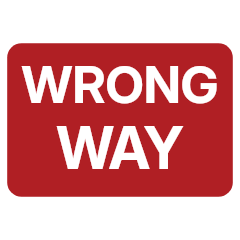
Show answer
Answer D: The sign that forbids entering that roadway at all
The two work as a pair at ramp terminals: one keeps drivers from turning in, and this one sits farther along to catch a driver who has already entered.
-
19. You are behind a snow plow working on a highway. What is the correct way to drive?
Show answer
Answer C: Stay well back and do not try to pass it
A plow throws snow, runs wider than its body and works on the poor surface ahead of it, so the cleared road behind it is the safest place to be.
-
20. You reach an intersection showing a steady red light, and a stop line is painted across your lane. Where must you bring the vehicle to a complete stop?
Show answer
Answer C: Before the stop line
A steady red requires a complete stop before the marked stop line. Where there is no stop line you stop before the crosswalk, and where there is neither, before entering the intersection.
-
21. You find that your shoulder belt has some slack in it. Why does that matter?
Show answer
Answer D: You travel further before the belt restrains you, so injuries are worse
Slack lets your body build up speed before the belt takes hold, which increases the forces on you and the risk of hitting the interior.
-
22. Can a driver be charged with impaired driving after taking a legal over the counter medicine?
Show answer
Answer C: Yes, if the medicine impairs the ability to drive safely
Impaired driving laws cover any substance that affects driving, including cold remedies, allergy pills and sleep aids sold without a prescription.
-
23. On an unlit road, about how far ahead do high beams normally let you see?
Show answer
Answer D: About 350 to 500 feet ahead of the vehicle
High beams light roughly 350 to 500 feet of road and low beams far less, which is why night speeds have to be chosen around the beam, not the limit.
-
24. A yellow pennant-shaped sign is posted on the left side of a two-lane road facing you. What is it telling you?
Show answer
Answer B: You are entering a no-passing zone and may not start a pass
The pennant is placed on the left so that it faces the driver who might pull out, and it marks the beginning of a no-passing zone.
-
25. You are turning right off a street into a parking lot driveway that crosses a bike lane and a sidewalk. Who has the right of way?
Show answer
Answer D: Pedestrians on the sidewalk and riders in the bike lane
Turning into a driveway means crossing the paths of people who were already traveling straight, so you give way to both the bike lane and the sidewalk.
-
26. You are turning left across tracks that run along the center of the street. What should you do before crossing them?
Show answer
Answer B: Look along the tracks in both directions and cross only when clear
Rail vehicles running in the street can arrive from either direction and cannot stop quickly, so look along the tracks before you turn across them.
-
27. Besides motorist services and tourist information, a blue sign background is also used for
Show answer
Answer B: evacuation route signing
Blue is assigned to road user services, tourist information and evacuation routes, so hurricane and other evacuation routes are signed in blue.
-
28. An officer directing traffic faces you and holds one hand up with the open palm toward your vehicle. What does the gesture mean?
Show answer
Answer D: Stop before reaching the officer
A raised open palm shown toward a driver is the standard signal to stop.
-
29. How much uninsured vehicle coverage must a Maine policy carry?
Show answer
Answer B: The same amount as the policy's bodily injury liability unless the buyer rejects it in writing
Maine requires uninsured vehicle coverage at least equal to the policy's bodily injury liability limits unless the purchaser signs a written rejection on the insurer's form, and it never falls below the statutory minimum.
-
30. What is the best way to handle the radio, the music player and the climate controls on a trip?
Show answer
Answer B: Set them before you start driving and let a passenger handle changes
Fiddling with controls takes eyes and hands off the driving task. Setting them before you move and letting a passenger make later changes removes the distraction entirely.