
Maine BMV Permit Practice Test 36
- Questions30
- Correct to pass24
- Passing score80%
- Minimum age15 years
-
1. You are driving through patchy fog on a highway. What should you be ready for?
Show answer
Answer B: Sudden dense banks where visibility drops within a few car lengths
Patchy fog can go from clear to nearly blind in a moment, so keep your speed low enough that a sudden bank does not leave you without room.
-
2. What must a Maine driver do when an emergency vehicle approaches using both its lights and its siren?
Show answer
Answer A: Draw as near as practicable to the right hand curb and stop
Maine requires the driver to draw the vehicle as near as practicable to the right hand curb or edge of the way and bring it to a standstill.
-
3. How should a turn at an intersection be taken on a wet road?
Show answer
Answer C: Slow earlier than usual and steer smoothly through the corner
Wet pavement leaves less grip, so the speed must come off before the turn and the steering must be gentle enough not to break traction.
-
4. A traffic signal is dark and you reach the intersection at the same moment as a vehicle on your right. Who goes first?
Show answer
Answer A: The vehicle on your right, as at any all-way stop
A dark signal is treated as an all-way stop, and the usual tie-breaker then applies: the vehicle on the right goes first.
-
5. It is dark, it is raining and you are towing a trailer. How should you set your following gap?
Show answer
Answer B: Add extra seconds for each condition, well beyond three
Each factor that lengthens your stopping distance or shortens your view calls for another second or more, and they add up when several occur together.
-
6. A center lane is bordered by a solid yellow line on the outside and a broken yellow line on the inside, with turn arrows painted inside it. What is that lane for?
Show answer
Answer C: Left turns made by traffic traveling in either direction
That marking pattern identifies a two-way left-turn lane, which drivers approaching from both directions may use to prepare for a left turn.
-
7. What is a good habit when you open the door on the traffic side of a parked car?
Show answer
Answer C: Use the hand farther from the door, which turns you to look back
Reaching across with the far hand rotates your body and brings the mirror and the road behind into view before the door moves.
-
8. How does being tired change your total stopping distance?
Show answer
Answer A: It lengthens it, because you take longer to notice and react
Fatigue stretches perception and reaction time, and every extra fraction of a second is added distance before the brakes even begin to work.
-
9. Which combination best reduces the chance of hydroplaning?
Show answer
Answer D: Good tread depth, correct tire pressure and lower speed in the rain
Tread channels water away, correct pressure keeps the tire's shape, and lower speed gives the tire time to push water aside. Hydroplaning can begin at surprisingly modest speeds.
-
10. How do stimulant drugs such as amphetamines or cocaine typically affect driving?
Show answer
Answer D: They can make the driver overconfident and more willing to take risks
Stimulants create a false sense of alertness and encourage aggressive, risky driving. When they wear off, sudden fatigue can follow.
-
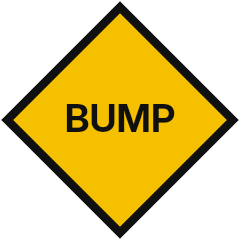
11. Why does this warning matter more on a motorcycle than in a car?
Show answer
Answer B: Because a sudden jolt can unsettle a two-wheeled machine and the rider can lose control
A jolt can push a motorcycle off line or lift a wheel, so a rider slows early, comes slightly off the seat and keeps a relaxed but firm hold on the handlebars.
-
12. You are driving at night through heavy falling snow. Which headlight setting works better and why?
Show answer
Answer C: Low beams, because high beams bounce off the falling flakes back at you
Falling snow reflects light the way fog does, so high beams build a white wall of glare while low beams still give a usable view.
-
13. When is a child ready to use a vehicle seat belt without a booster seat?
Show answer
Answer A: When the lap belt lies across the upper thighs and the shoulder belt crosses the chest
Belt fit, not age, decides readiness. Until the child is tall enough for the lap belt to sit on the thighs and the shoulder belt on the chest, a booster is needed.
-
14. You are driving in fog so thick that you can barely see the vehicle ahead. Which pavement marking is the best guide for staying in your lane?
Show answer
Answer A: The white edge line on the right side of the road
The right edge line keeps you positioned away from oncoming traffic and is easy to follow at low speed. Following tail lights closely tempts you to drive faster than you can see.
-
15. You have turned right into the nearest lane but you need the left lane soon. When should you move over?
Show answer
Answer A: After the turn is finished, once you have checked mirrors and blind spot
Complete the turn in the proper lane first, then make a normal lane change with mirror and blind spot checks once you are established on the new street.
-
16. You are waiting to turn left and a motorcycle is approaching from the opposite direction. Why should you take extra care judging its speed and distance?
Show answer
Answer A: Its small size makes it look farther away and slower than it really is
A motorcycle's narrow profile fools the eye, so drivers often misjudge how soon it will arrive. Left turns across an oncoming motorcycle are a leading cause of rider deaths.
-
17. You are stopped in a shared through and right-turn lane with your right signal on, and a bicyclist rides up along your right side. What should you do?
Show answer
Answer A: Let the bicyclist clear the intersection or move ahead before you turn
A cyclist alongside your right side is in the path your turn will sweep across, so wait until that space is clear before turning.
-
18. What makes up the total distance needed to bring a vehicle to a stop?
Show answer
Answer A: The distance covered while you perceive the hazard, the distance covered while you react, and the braking distance
Total stopping distance combines the ground covered while you notice the hazard, the ground covered while you move your foot to the brake, and the ground covered while the brakes slow the vehicle.
-
19. Apart from serious offenses, what else makes a Maine driver a habitual offender?
Show answer
Answer A: Ten or more moving violations from separate acts within 5 years
The second route to habitual offender status in Maine is ten or more convictions or adjudications for moving violations arising out of separate acts within 5 years.
-
20. You find that the road surface has turned to sheet ice. What speed is appropriate?
Show answer
Answer A: A crawl, slow enough that you could stop without braking hard
Ice can cut grip to a fraction of normal, so stopping takes many times the usual distance and only a crawl leaves any margin.
-
21. Why is a wet road at night harder to read than the same road in daylight?
Show answer
Answer A: The wet surface reflects light away and swallows the lane markings
A film of water sends your headlight beam onward instead of back to you, so lines, edges and people in dark clothing almost disappear.
-
22. Which sign shape is reserved for one message only, the requirement to stop?
Show answer
Answer A: The octagon
The octagon is used for the stop sign and for no other message, so the outline alone identifies the requirement even when the legend is hard to read.
-
23. A flashing red arrow is displayed for your turning lane. What does it require?
Show answer
Answer D: Stopping, then turning when the way is clear
A flashing red arrow is treated like a stop sign for that movement: come to a full stop, then turn when it is safe and no one has to be cut off.
-
24. The lane you are in has a right-turn-only arrow painted on the pavement. What must you do?
Show answer
Answer C: Turn right, because a lane-use arrow is a legal requirement
Lane-use arrows painted on the pavement are regulatory markings, so a driver in that lane must travel in the direction shown.
-
25. The overhead signal above your lane changes to a steady yellow X. What should you do?
Show answer
Answer B: Prepare to move out of that lane
A steady yellow X warns that the lane is about to close, so drivers should get ready to vacate it in favor of an open lane.
-
26. What are Maine's minimum liability limits for a registered vehicle?
Show answer
Answer A: 50,000 dollars per person, 100,000 dollars per accident and 25,000 dollars for property
Maine requires at least 50,000 dollars for injury to or death of one person, 100,000 dollars for one accident and 25,000 dollars for property damage, for each vehicle registered.
-
27. A bike lane on your right is marked with a dashed line for the last stretch before the corner. What does that dashed section allow you to do?
Show answer
Answer D: Merge into the bike lane after checking, and turn right from there
The dashed section is where drivers are meant to merge into the bike lane before turning, which puts cyclists behind the vehicle instead of beside it.
-
28. What is the safest way to deal with a vehicle sitting in your blind spot?
Show answer
Answer A: Slow a little or move ahead so that it is no longer beside you
You cannot control the other driver, but you can change your own speed so that the vehicle is no longer hidden beside you.
-
29. A row of solid white triangles points toward you across your lane. What does it mark?
Show answer
Answer A: The place to yield to traffic or people ahead
A yield line of triangles shows drivers exactly where to give way, and it is used at roundabouts and at midblock crosswalks.
-
30. There is a driveway and a side street between you and the corner where you will turn right. When should you signal?
Show answer
Answer C: After passing the openings, so nobody pulls out in front of you
A signal switched on before an opening tells drivers waiting there that you are turning in, and they may pull out into your path.