
Maine BMV Permit Practice Test 39
- Questions30
- Correct to pass24
- Passing score80%
- Minimum age15 years
-
1. You have to leave a trailer parked on a slope. What extra step protects it?
Show answer
Answer D: Chock the trailer wheels as well as setting the brake
Chocks physically block the wheels, which is the only thing that still holds if a brake or a coupling lets go.
-
2. What does Maine require when you meet an emergency vehicle stopped on the roadside?
Show answer
Answer B: Slow down and yield, moving to the next lane if it is possible to do so safely
Maine tells drivers to slow and yield the right of way, changing to the next lane when it is safe and otherwise passing slowly with caution.
-
3. A motorcycle ahead of you is weaving slightly as it crosses a stretch of grooved pavement. What should you do?
Show answer
Answer D: Give the rider extra room until the surface improves
Grooves, metal plates and loose material affect a motorcycle far more than a car, so back off and let the rider deal with the surface.
-
4. Traffic is backed up beyond a railroad crossing. When may you start across the tracks?
Show answer
Answer B: Only when there is room for your whole vehicle on the far side
Never enter a crossing you cannot clear; a vehicle stopped on the tracks in a queue has nowhere to go if the signals start.
-
5. Does using a hands free device remove the risk of distraction?
Show answer
Answer A: No, the conversation still takes attention away from driving
Hands free equipment removes the manual part of the distraction but not the mental part, and a driver deep in conversation can look straight at a hazard without registering it.
-
6. The crossbuck, formed by two rectangular arms crossed in an X, is placed
Show answer
Answer D: on each highway approach to a railroad grade crossing
The crossbuck marks the location of a highway-rail grade crossing and is required on each highway approach to that crossing.
-
7. You are stopped at a stop sign where your road ends at a two-way through street and you plan to turn left. What must you yield to?
Show answer
Answer B: Traffic from both directions and any pedestrians crossing
A left turn from the stem of a T crosses the near lane and joins the far one, so you give way to traffic in both directions and to pedestrians.
-
8. The light turns yellow when your front wheels are already past the stop line inside the intersection. What should you do?
Show answer
Answer B: Keep going and clear the intersection without speeding up
Once you are legally in the intersection the safest and correct action is to continue through and clear it, without accelerating.
-
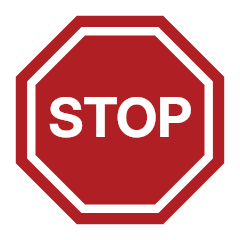
9. At an intersection where every approach carries this sign, two drivers arrive at exactly the same instant. Which of them goes first?
Show answer
Answer C: The driver on the right
Order of arrival decides who goes first, and when two vehicles arrive together the driver on the right proceeds while the other gives way.
-
10. A crossing guard steps into the roadway ahead of this sign with one hand raised. What must the driver do?

Show answer
Answer B: Stop and stay stopped until the guard waves traffic on
An adult guard is controlling traffic at that crossing, so the instruction given by that person governs and the driver waits to be released.
-
11. At an intersection that uses a lagging left turn, when is the left-turn arrow displayed?
Show answer
Answer B: After the through movement has run
A lagging left turn phase runs at the end of the green rather than the start, so a driver waiting to turn should not assume the arrow has been missed.
-
12. What should you check on the hitch before towing a trailer?
Show answer
Answer B: That the coupler is locked and the safety chains are crossed underneath
The coupler must be latched and pinned, and the chains crossed under the tongue so they cradle it if the coupling lets go.
-
13. How long may the Maine Secretary of State suspend a license for refusing a chemical test?
Show answer
Answer A: For a period of up to six years
Maine's implied consent rules allow an administrative suspension of up to six years for refusal, imposed without any court action.
-
14. Your left-turn lane faces a steady green ball and oncoming traffic is heavy. What are you allowed to do?
Show answer
Answer C: Move into the intersection and turn when a safe gap appears
A green ball permits the turn but gives no priority, so you may move into the intersection and wait there for a gap in the oncoming traffic.
-
15. Once you have parallel parked, how close to the curb should your wheels be?
Show answer
Answer C: Within the distance your state allows, commonly 12 to 18 inches
Parking close to and parallel with the curb keeps the vehicle out of the traffic lane without damaging the tires; each state sets the exact maximum, usually 12 inches and 18 inches in some states.
-
16. You are parking facing downhill on a street with a curb. Which way should the front wheels point?
Show answer
Answer A: Toward the curb, so the vehicle would roll into it if it moved
Turning the wheels toward the curb when facing downhill means a vehicle that starts to roll is stopped by the curb instead of entering the traffic lane.
-
17. An arrow panel at a work zone displays a flashing arrow pointing to the left. What does it require?
Show answer
Answer C: Move out of the closed lane into the lane on the left
A flashing or sequential arrow on an arrow panel directs traffic out of a closed lane and into the lane the arrow points to.
-
18. You are waiting to turn left across two oncoming lanes when a driver in the near lane stops and waves you through. What should you do?
Show answer
Answer D: Turn only after checking the far lane yourself
The waving driver cannot give away the right of way of the traffic in the second lane, which may not be stopping at all.
-
19. Someone has stepped into a marked crosswalk in the middle of a block ahead of you. What should you do?
Show answer
Answer A: Slow down, stop before the markings and let the person cross the street
A marked mid-block crosswalk carries the same duty as one at a corner: give way to the person crossing, stopping if that is what letting them cross safely takes.
-
20. What is lane splitting?
Show answer
Answer B: A motorcycle riding between two lanes of traffic moving the same way
Lane splitting means riding along the line between two lanes of traffic going in the same direction rather than staying within a lane.
-
21. In a work zone the temporary lane lines conflict with the old lines still visible on the pavement. Which do you follow?
Show answer
Answer C: The temporary markings, which show the current traffic pattern
Temporary markings define the traffic pattern in force, and the old lines are simply the layout that no longer applies.
-
22. A center lane is bordered by a solid yellow line on the outside and a broken yellow line on the inside, with left-turn arrows painted in it. How may you use that lane?
Show answer
Answer A: Only to make a left turn or to prepare for one from either direction
That marking identifies a two-way left turn lane, which may only be used for left turns or to prepare for a left turn and never for travel or passing.
-
23. How does Maine enforce its ban on smoking in a vehicle when a minor is present?
Show answer
Answer B: A 50 dollar fine applies, and the violation alone is no ground to search the vehicle
Maine sets a 50 dollar fine for smoking in a vehicle when a minor is present and forbids inspecting or searching the vehicle or its occupants solely because of that violation.
-
24. How many convictions for serious offenses such as OUI or driving to endanger make a Maine driver a habitual offender?
Show answer
Answer C: Three arising out of separate acts committed within a 5 year period
Maine declares a driver a habitual offender on three or more convictions for the listed serious offenses arising out of separate acts committed within 5 years.
-
25. You are descending a long steep grade with a loaded truck close behind you. What should you do?
Show answer
Answer A: Hold a steady speed and let it pass when it can
Gravity pushes a loaded truck downhill and it cannot slow quickly, so give it a predictable speed and room to get by rather than braking in front of it.
-
26. Warning signs such as stop ahead, yield ahead and signal ahead are installed mainly where
Show answer
Answer B: the traffic control device cannot be seen from far enough away
These advance warning signs are used when a crest, curve or obstruction keeps the stop sign, yield sign or signal from coming into view in time for a driver to react.
-
27. The queue for an exit ramp has backed up into the right lane of the highway. What should you do if you want that exit?
Show answer
Answer B: Join the back of the queue in the lane instead of cutting in later
Passing a queue and forcing in at the front stops the whole line, and using the shoulder puts you where broken-down vehicles are expected to be.
-
28. On loose gravel or deep fresh snow, how does an antilock system affect the stopping distance?
Show answer
Answer D: It can lengthen it, although you keep the ability to steer
On loose surfaces a locked wheel piles up a wedge of gravel or snow that helps it stop, so the antilock stop can be longer even though steering still works.
-
29. A yellow diamond shows two lanes narrowing into one. What does it require of a driver?
Show answer
Answer D: Adjusting speed and merging before the lane disappears
The lane ends sign gives notice that one lane will be dropped, so drivers should adjust speed and blend into the continuing lane in good time.
-
30. A yellow horizontal rectangular sign showing one large arrow pointing left or right, facing traffic on the far side of a sharp bend, tells the driver
Show answer
Answer C: which way the roadway turns at that point
The large arrow sign is mounted on the outside of a sharp change in alignment so that a driver approaching head on immediately sees which way the road goes.