
Maine BMV Motorcycle Practice Test 1
- Questions25
- Correct to pass20
- Passing score80%
- Minimum age16 years
-
1. A city transit bus ahead of you has stopped at the curb with its passenger door open. What does the law require of you?
Show answer
Answer D: Nothing special, but pass slowly and watch for people
The mandatory stop applies to a school bus showing red flashing lights, not to a transit bus, though a careful driver still slows for crossing passengers.
-
2. What suspension does Maine impose on a juvenile provisional licensee for a first OUI or for operating with any alcohol at all?
Show answer
Answer D: One year
A first OUI or a first violation of the zero alcohol rule costs a juvenile provisional licensee a one year suspension, and a second costs two years.
-
3. The school bus stop ahead sign is installed where
Show answer
Answer C: a school bus stop cannot be seen from far enough away by approaching drivers
This school warning sign is used in advance of a bus stop that lacks adequate sight distance and cannot be relocated, so drivers are warned before the stopped bus comes into view.
-
4. Which of these is a known cause of a high speed wobble?
Show answer
Answer C: Incorrect tire pressure or a load carried too far back and too high
Wobble is usually traced to tires, wheels, loading or poorly mounted accessories such as a windshield or fairing, so check pressures and how the machine is loaded.
-
5. The signal ahead turns yellow while you are approaching it. What does the yellow light mean?
Show answer
Answer C: The red is coming; stop if you can do so safely
A steady yellow warns that the red is next. Stop if you can do so safely; enter the intersection only when stopping would be dangerous.
-
6. How should a rider use a motorcycle fitted with antilock brakes in an emergency stop?
Show answer
Answer D: Apply firm, steady pressure to both brakes and keep it there
An antilock system releases and reapplies pressure far faster than a rider can, but only while the rider keeps holding the brakes on.
-
7. You have just been involved in a crash on a city street. Which sequence of first steps is correct?
Show answer
Answer A: Stop where you are, check everyone for injuries, and then make the scene safe
You are required to stop, and the first priority at the scene is people, followed by preventing a second collision.
-
8. What makes a left turn protected rather than permissive?
Show answer
Answer B: Oncoming traffic is held by a red signal while you have a green arrow
A protected turn is one where the conflicting movements are stopped by their own signal, which is what the green arrow indicates.
-
9. What should the operator do before a bump, a sharp turn or a sudden stop?
Show answer
Answer C: Warn the passenger so they can brace for it
A warning lets the passenger tighten their grip and prepare, which keeps the passenger weight from shifting unexpectedly at the worst moment.
-
10. What kind of sole and heel suit motorcycle boots?
Show answer
Answer A: A hard, slip resistant sole with a low heel that will not catch
Boots have to grip the pavement when you put a foot down and grip the footrests while you ride, and a tall heel can catch on the ground or on the machine.
-
11. Are ordinary eyeglasses or sunglasses adequate eye protection for riding?
Show answer
Answer B: No, since they can shatter and let wind reach the eyes from the side
Everyday lenses are not made to resist impact and leave the eyes open to wind and debris, so a face shield or goggles are needed instead.
-
12. How long should a rider stay in the oncoming lane while passing?
Show answer
Answer D: Only as long as completing the pass safely requires
Every extra second in the oncoming lane is exposure with no benefit, so the rider passes decisively and returns as soon as the road behind is clear.
-
13. A mixed drink is made with two shots of spirits. How much alcohol is that?
Show answer
Answer C: About two standard drinks
A standard drink is a fixed amount of pure alcohol, so a glass poured with two measures counts as two drinks however it is served.
-
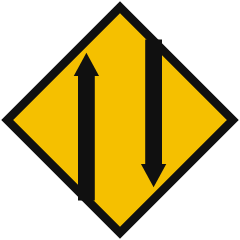
14. Which action becomes clearly more risky beyond this sign?
Show answer
Answer A: Using the left side of the roadway to overtake
With vehicles coming the other way on the same pavement, overtaking on the left needs enough clear road to pull out, pass and return, which is often not available.
-
15. On a two-lane road with a broken yellow center line, may you cross it to turn into a driveway on the left?
Show answer
Answer C: Yes, when it is safe and the oncoming lane is clear
A broken center line may be crossed for a pass or for a left turn into a road or a driveway, once the oncoming lane is clear.
-
16. You are driving along a street lined with parked cars. What should you watch for?
Show answer
Answer B: Doors opening, vehicles pulling out and pedestrians stepping from between cars
Parked cars hide people and can move without warning. Keep as much space from them as you safely can and cover the brake.
-
17. When is passing another vehicle on the right generally permitted?
Show answer
Answer C: When the road has two or more lanes in your direction, or the vehicle ahead is turning left and there is room without leaving the pavement
Passing on the right is limited to situations where a lawful lane exists for it or the vehicle ahead is turning left, and it may never be done by driving onto the shoulder.
-
18. The route marker used for an Interstate highway is a shield with
Show answer
Answer A: white numerals on a blue field under a red band carrying the word INTERSTATE
The Interstate route marker is a cutout shield with a white border, the word INTERSTATE in white on red across the top and the route number in white on blue.
-
19. Why should you make sure your turn signal has stopped flashing after a lane change?
Show answer
Answer A: A signal left flashing tells other drivers that you intend to move again
Other drivers act on your signals, so one that is left on gives them false information about what you are about to do.
-
20. Which stopped vehicles does Maine's move over duty protect?
Show answer
Answer B: Authorized emergency vehicles and public service vehicles
Maine's move over provision covers both authorized emergency vehicles and public service vehicles stopped on the way.
-
21. A large group has been divided into smaller groups. What should be done between them?
Show answer
Answer A: Leave a gap big enough for other vehicles to move in and pass safely
A gap between sub groups lets other traffic pass or merge without cutting into a formation, which keeps drivers from making sudden moves around the riders.
-
22. You are turning left from a two-way street onto another two-way street. Where should you begin and end the turn?
Show answer
Answer B: Begin in the lane just right of the center line and finish just right of the center line of the new street
You approach a left turn from the lane closest to the center line and enter the new roadway just to the right of its center line, which keeps you clear of oncoming traffic.
-
23. Some toll facilities use signs and markings with a purple background or a purple stripe. What do they identify?
Show answer
Answer D: Lanes reserved for vehicles with an electronic toll account
Purple is assigned to lanes and ramps restricted to vehicles with a registered electronic toll collection account, so drivers without one must stay out.
-
24. Why should a rider avoid riding through a puddle that spans the lane?
Show answer
Answer D: It can hide a deep hole or broken pavement under the surface
Standing water conceals what is underneath it, so treat a puddle as an unknown surface and go around it whenever you safely can.
-
25. A driver is following your motorcycle much too closely. What should you do?
Show answer
Answer B: Ease off the throttle and open more space ahead so the driver can pass
Slowing gradually and opening a bigger gap in front encourages the tailgater to pass and gives the rider room to stop gently instead of hard.