
Maine BMV Motorcycle Practice Test 26
- Questions25
- Correct to pass20
- Passing score80%
- Minimum age16 years
-
1. When should a staggered group change to single file?
Show answer
Answer C: In curves, in turns, and when entering or leaving a highway
Curves, turns and highway entrances and exits require the full width of the lane, so the group rides single file at those points.
-
2. A pedestrian steps off the curb without looking your way. What should you assume?
Show answer
Answer B: That the person has not seen you at all, and be ready to stop for them
Defensive driving means assuming you have not been seen until there is clear evidence that you have.
-
3. You reach a red light with a sign reading NO TURN ON RED. What may you do?
Show answer
Answer D: Wait for the green; no turn is allowed while the light is red
That sign removes the usual permission to turn on red at the intersection, so you must wait for a green indication.
-
4. A yellow diamond showing arrows arranged in a circle warns of
Show answer
Answer B: a circular intersection such as a roundabout ahead
The circular intersection warning sign announces a roundabout or traffic circle so drivers can slow down and prepare to yield to traffic already circulating.
-
5. A center lane is bordered by a solid yellow line on the outside and a broken yellow line on the inside, with left-turn arrows painted in it. How may you use that lane?
Show answer
Answer A: Only to make a left turn or to prepare for one from either direction
That marking identifies a two-way left turn lane, which may only be used for left turns or to prepare for a left turn and never for travel or passing.
-
6. On dry pavement in good weather, what is the smallest following gap you should keep?
Show answer
Answer A: About three seconds behind the vehicle ahead
Three seconds is the accepted minimum on dry roads in good visibility, and the gap should be longer in poor conditions.
-
7. Why can a motorcycle ahead of you slow down without any warning light showing?
Show answer
Answer B: The rider may slow by downshifting or rolling off
Riders often lose speed by closing the throttle or changing down, which does not switch on the brake light, so watch the machine itself and keep back.
-
8. Why does a long downhill grade lengthen the distance you need to stop?
Show answer
Answer C: Because gravity keeps pulling the vehicle forward as you brake
On a downgrade gravity works with the vehicle and against the brakes, so the same speed needs noticeably more distance than it would on level ground.
-
9. A sign with a brown background and a white legend guides road users to
Show answer
Answer B: parks, campgrounds and other recreational or cultural sites
Brown is reserved for recreational and cultural interest area signing, such as parks, historic sites and scenic areas.
-
10. During which period may a Maine vehicle not run tires with metal studs?
Show answer
Answer C: From the first day of May to the first day of October
Maine bans metal studded tires from the first day of May to the first day of October, with exceptions for fire department vehicles and school buses and a permit system run by the Commissioner of Transportation.
-
11. Why is it useful to watch the vehicle two or three places ahead of you?
Show answer
Answer C: You get an earlier warning of slowing traffic than brake lights give
Trouble travels back through a line of traffic, so seeing it start several vehicles ahead gives you a head start on braking.
-
12. What must a Maine driver do when an emergency vehicle approaches using both its lights and its siren?
Show answer
Answer A: Draw as near as practicable to the right hand curb and stop
Maine requires the driver to draw the vehicle as near as practicable to the right hand curb or edge of the way and bring it to a standstill.
-
13. A warning sign showing two children on a see-saw is posted beside a residential street. What does it mean?
Show answer
Answer D: A play area lies beside the road and children may run out
The playground sign warns that children are present next to the roadway and may enter it without looking, so drivers should cover the brake and slow down.
-
14. The vehicle in front of you has stopped and is waiting to turn left, and there is a paved shoulder to the right. May you use it to get by?
Show answer
Answer D: No, in most states a pass may not be made by leaving the paved travel lanes
Passing on the right is normally lawful only inside the marked travel lanes, and most states prohibit driving onto the shoulder to get around a turning vehicle; the few states that allow it attach strict conditions.
-
15. Which federal standard must a motorcycle helmet meet to be sold for on-road use in the United States?
Show answer
Answer B: FMVSS No. 218
Federal Motor Vehicle Safety Standard No. 218 sets the impact, penetration and retention requirements for motorcycle helmets sold in the United States.
-
16. Why do many crashes happen on routes the driver knows very well?
Show answer
Answer D: Familiar roads let attention slip into routine
When a route is automatic the mind wanders and hazards get missed, which is why a well known road deserves the same attention as a strange one.
-
17. Why do groups agree on a set of hand signals before setting off?
Show answer
Answer B: Because engine noise and helmets make speech useless between moving machines
Riders cannot talk to each other while moving, so agreed signals for hazards, stops, fuel and single file keep the whole group informed.
-
18. An oncoming vehicle keeps its high beam on and dazzles you. What should you do?
Show answer
Answer C: Look toward the right edge of your lane and slow until it has passed
Shifting your gaze to the right edge of the lane keeps you on line without staring into the glare, and slowing gives you time if something is hidden in it.
-
19. Why is parking too close to a street corner prohibited?
Show answer
Answer D: Because it hides approaching traffic and pedestrians
A vehicle parked at a corner blocks the view that both drivers and pedestrians need before entering the intersection.
-
20. What is the minimum fine in Maine for failing to slow to a careful and prudent speed in an emergency zone?
Show answer
Answer B: 250 dollars
Maine's speed statute requires a careful and prudent speed when approaching an emergency vehicle displaying activated lights and sets a fine of at least 250 dollars for failing to do so.
-
21. A funeral procession with headlights on is crossing an intersection when your light turns green. What should you do?
Show answer
Answer A: Wait and let the whole procession go through
Most states let a funeral procession stay together once the lead vehicle has lawfully entered an intersection, and in every state you must yield to vehicles already in the intersection, so wait until the line has passed.
-
22. You are approaching an intersection in a line of traffic. What can you do to be more visible to a driver waiting to pull out?
Show answer
Answer D: Move to a lane position where you are not hidden behind the vehicle ahead
A motorcycle tucked directly behind a larger vehicle is invisible to a waiting driver until the moment it appears, so the rider moves to where the headlight can be seen.
-
23. Where must the engine cut-off switch be set before the starter button will crank the engine?
Show answer
Answer A: In the run position
The cut-off switch sits in the ignition circuit, so the engine will not start or run while it is set to off.
-
24. You arrive at an intersection where the traffic signals are completely dark after a power failure. What should you do?
Show answer
Answer A: Treat the intersection as an all-way stop and take turns
When a signal is dark or out of order, drivers on every approach must stop and proceed in turn, exactly as at a four-way stop.
-
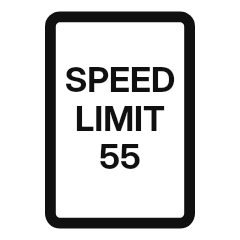
25. Heavy rain has left standing water on the road where this sign is posted. What does the law expect of the driver?
Show answer
Answer C: Driving below the posted figure, at a speed that suits the conditions
Drivers must adapt to conditions, so in rain, fog, snow or dense traffic the safe speed falls below the posted maximum and keeping to that maximum can itself be an offense.