
Maine BMV Motorcycle Practice Test 40
- Questions25
- Correct to pass20
- Passing score80%
- Minimum age16 years
-
1. You are traveling at 55 mph and see a vehicle ahead moving at about 15 mph. What is the hazard?
Show answer
Answer A: You reach it far sooner than you expect
At a 40 mph difference you cover the gap in a few seconds, which is why drivers strike slow vehicles they saw in plenty of time.
-
2. A driver is following you far too closely. What is the best response?
Show answer
Answer D: Increase your own following distance and let the driver pass when it is safe
More room ahead of you means you can slow gradually instead of braking hard, which reduces the chance of being struck from behind, and letting the driver by removes the problem entirely.
-
3. What do the letters in the SEE riding strategy stand for?
Show answer
Answer B: Search, Evaluate, Execute
Riders search for hazards, evaluate how those hazards could interact, and execute a plan by adjusting speed, position or communication.
-
4. Why is hard braking the wrong response to a tire blowout at speed?
Show answer
Answer C: Because it can pull the vehicle further out of line and start it spinning
With one tire gone the braking forces are uneven, so heavy braking increases the pull to one side and can spin the vehicle.
-
5. You need to reverse direction on a busy street. Which choice is usually safest?
Show answer
Answer D: Driving around the block and using the intersections instead
Going around the block uses normal turns at controlled intersections instead of stopping across live traffic lanes.
-
6. About how far does a vehicle travel in one second at 60 mph?
Show answer
Answer A: About 88 feet
At 60 mph you cover about 88 feet every second, which is why a glance of only two or three seconds means driving the length of several vehicles blind.
-
7. What does a steady yellow traffic light tell the driver facing it?
Show answer
Answer A: The green movement is ending and a red indication is about to appear
A steady yellow warns that the related green movement is being terminated and that red will follow, so you should stop if you can do so safely.
-
8. What single action does Maine allow a driver to perform on a telephone mounted in the vehicle?
Show answer
Answer A: One tap to activate or deactivate it
Maine permits a driver who is otherwise allowed to use hands-free mode to activate or deactivate a mounted device with a single touch.
-
9. You are already inside a roundabout when an emergency vehicle approaches with lights and siren. What should you do?
Show answer
Answer B: Continue to your exit, leave the roundabout, then pull over and stop
Stopping inside a roundabout blocks the circulating roadway, so you should exit first and then pull over clear of the intersection.
-
10. There is a driveway and a side street between you and the corner where you will turn right. When should you signal?
Show answer
Answer C: After passing the openings, so nobody pulls out in front of you
A signal switched on before an opening tells drivers waiting there that you are turning in, and they may pull out into your path.
-
11. You are traveling in the same direction as a funeral procession and want to get ahead of it. What should you not do?
Show answer
Answer B: Driving in between the vehicles of the procession
Most states prohibit driving into or through a funeral procession, and cutting into the line leaves the drivers behind with no lead vehicle to follow, so go around only where passing is permitted.
-
12. You want to turn right at a steady red light and no sign prohibits the turn. What is required?
Show answer
Answer B: Come to a complete stop, then yield to traffic and pedestrians before turning
A right turn on a steady red is permitted only after a complete stop and only after yielding to cross traffic and to pedestrians, and a posted sign can prohibit it entirely.
-
13. You realize your tires are running on ice. Which set of inputs is safest?
Show answer
Answer C: Gentle steering, no sudden braking, and no sudden acceleration
Whatever grip is left is used up at once by any sudden input, so every movement of wheel, brake and accelerator must be slow and small.
-
14. You are about to pass a bicyclist on a narrow two-lane road. What is the correct way to do it?
Show answer
Answer A: Wait for a clear gap and move well left, giving the rider wide space
Pass a cyclist as you would a car: wait for clear road, change lane position to leave generous clearance, and return only when the rider is well behind you.
-
15. What causes the side to side motion a rider feels when crossing a steel grid deck or rain grooves?
Show answer
Answer C: The tires following the ridges and grooves, which is normal and harmless
The tread follows the pattern in the surface, which produces a wandering feel. The motorcycle is not out of control, so relax on the bars and hold your speed.
-
16. Which sign tells you that the vehicles ahead are part of a funeral procession?
Show answer
Answer C: Headlights burning in daylight, with small flags or markers on the vehicles
Processions are normally identified by daytime headlights, hazard lights and flags or windshield markers, not by emergency lights or sirens.
-
17. What must a driver be ready for beyond this sign?
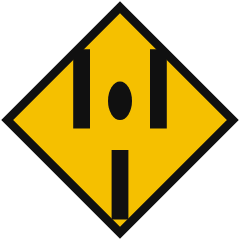
Show answer
Answer C: Vehicles approaching from the opposite direction in the next lane over
The separation between the two directions runs out, so from that point oncoming vehicles share the same pavement and the driver has to keep right.
-
18. The crossbuck, formed by two rectangular arms crossed in an X, is placed
Show answer
Answer D: on each highway approach to a railroad grade crossing
The crossbuck marks the location of a highway-rail grade crossing and is required on each highway approach to that crossing.
-
19. Why is parking next to a fire hydrant or in a marked fire lane prohibited?
Show answer
Answer D: It would delay firefighters who need immediate access to the hydrant or the building
Fire hydrants and fire lanes must remain clear at all times so emergency crews can connect hoses and reach a building without delay.
-
20. You are waiting to turn left at a solid green light with no green arrow. Oncoming traffic is approaching. What should you do?
Show answer
Answer A: Yield to the oncoming traffic and turn only when there is a safe gap
A solid green light permits the left turn but does not protect it, so you must yield to oncoming vehicles and to pedestrians before turning.
-
21. You spot a deep pothole that the riders behind you will not be able to see until it is too late. What is the usual way to warn them?
Show answer
Answer B: Point at it with a hand or a foot on the side it lies on
Pointing at the hazard on the correct side tells the riders behind both that something is there and where in the lane it is.
-
22. A signal beside a fire station stays dark until apparatus is about to leave, when it shows yellow and then red. What must a driver do?
Show answer
Answer B: Stop on the red and wait until the signal goes dark again
An emergency vehicle signal is a real traffic signal, so its red indication must be obeyed while the apparatus pulls out into the street.
-
23. A rectangular red sign with the white words WRONG WAY means that
Show answer
Answer C: the driver is already traveling against the legal flow and must not continue
The wrong way sign uses a white legend and border on red and addresses a driver who has entered a ramp or one-way roadway in the wrong direction, who should stop and turn around safely.
-
24. A city transit bus at a stop ahead of you switches on its left signal. What should you do?
Show answer
Answer D: Slow and let the bus pull back into traffic
A bus needs a long gap to rejoin traffic, and yielding to a signaling transit bus keeps the whole line of traffic moving safely.
-
25. What should a rider understand about the horn on a motorcycle?
Show answer
Answer A: It is often weak and may not be heard, so it never replaces an escape route
A small horn competes with a closed car, a radio and traffic noise, so a rider plans a way out instead of trusting the horn to be heard.