
Maine BMV Motorcycle Practice Test 47
- Questions25
- Correct to pass20
- Passing score80%
- Minimum age16 years
-
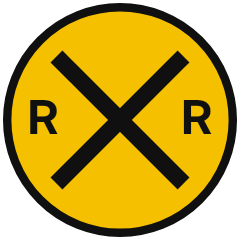
1. This sign leads to a crossing that has no gates and no flashing lights. What does that mean for the driver?
Show answer
Answer D: Nothing will warn of an approaching train, so the driver must check the tracks personally
At a passive crossing there is no active device to announce a train, so the whole judgment rests on the driver, who must approach slowly enough to stop after looking along the track.
-
2. On a narrow residential street, why does parking tight against the curb matter so much?
Show answer
Answer C: Because fire trucks and ambulances need the width to get through
Cars parked even a foot out from the curb on both sides can narrow a street until a fire truck or ambulance cannot pass.
-
3. How should the brake light be checked before a ride?
Show answer
Answer D: Confirm that the hand lever and the foot pedal each switch it on
Many motorcycles use a separate switch for each brake control, so both the lever and the pedal have to be tested one at a time.
-
4. A small signal face beside a bikeway shows red, yellow and green lenses that each carry a bicycle symbol. Whom does it control?
Show answer
Answer C: Bicyclists using that crossing or bikeway
A bicycle signal face governs bicycle movements only, and people on foot at the same corner still follow the pedestrian signal.
-
5. You turn from asphalt onto a loose gravel road. What should you do about your speed?
Show answer
Answer D: Lower it, since grip is reduced and stopping takes longer
Loose gravel gives far less grip than pavement, so speed must come down for both steering and stopping.
-
6. The front brake lever feels soft and travels almost to the handgrip. What should the rider do?
Show answer
Answer D: Leave the motorcycle where it is until the brake system has been inspected
A spongy lever usually means air or fluid loss in the system, and a brake in that condition can fail completely under hard use.
-
7. You are stopping for a red light in the rain and your stopping point is on a wide painted stop line and crosswalk. What should you do?
Show answer
Answer C: Slow earlier and gently, since wet paint offers much less grip than pavement
Painted stop lines and crosswalks turn slick when wet, so start braking early and squeeze gently rather than braking hard on the markings.
-
8. Where is a strong crosswind most likely to hit you suddenly?
Show answer
Answer D: Coming out of a tunnel or a cut onto an open bridge
Gusts arrive the moment you leave shelter, which is why bridge approaches and the ends of cuts and tunnels catch drivers out.
-
9. What limit does Maine place on motorcycle handlebars?
Show answer
Answer C: The handgrips must be no higher than the operator's shoulder level
Maine forbids operating a motorcycle on a public way with handlebars whose handgrips sit higher than the shoulder level of the operator.
-
10. What do the grooves in a tire tread do on a flooded road surface?
Show answer
Answer B: They give the water a way to escape so the tread can touch the road
Tread grooves pump water out from under the tire so rubber can meet pavement. A worn tread moves less water, so hydroplaning starts sooner.
-
11. A separate right-turn lane leads onto the cross street and carries a yield sign. What does it require?
Show answer
Answer D: Slowing and giving way to traffic and people, stopping if needed
A yield requires you to slow, give way to traffic in the lane you are joining and to pedestrians, and stop only if that is what safety demands.
-
12. The car ahead drifts across the lane line and back again several times. What should you do?
Show answer
Answer C: Assume that the driver is distracted or impaired, and keep well back
Drifting is a classic sign of a distracted, drowsy or impaired driver, and distance is your protection from all three.
-
13. You enter a work zone at night where one lane is closed and a flagger is on duty. What is the safest approach?
Show answer
Answer A: Slow early, merge before the closure and be ready to stop
Merging early at a reduced speed keeps the queue orderly and leaves you room to stop for equipment, workers or traffic that has halted ahead.
-
14. You approach a traffic signal that has already been green since it first came into view. What should you expect?
Show answer
Answer B: That it may change at any moment, so be ready to stop
A signal already green when you first see it is well into its cycle, so a rider covers the brakes and plans a stop rather than assuming a clear run.
-
15. A sign at the approach to a bridge reads WEIGHT LIMIT 10 TONS. What does the figure set?
Show answer
Answer B: The heaviest vehicle the bridge may legally carry
A weight limit sign is a regulation based on what the structure can bear, and it applies to the loaded weight of the whole vehicle.
-
16. The center line beside your lane is a broken yellow line. What does it allow?
Show answer
Answer D: You may cross into the opposing lane to pass when it is safe and clear
A broken yellow center line marks a passing zone where traffic in that direction may cross into the opposing lane to pass when the way ahead is clear.
-
17. Your left-turn lane shows a flashing yellow arrow. What does that indication allow?
Show answer
Answer B: A left turn after yielding to oncoming traffic and to pedestrians
A flashing yellow arrow marks a permissive left turn: the movement is allowed, but oncoming vehicles and pedestrians keep the right-of-way.
-
18. It is hot and a rider wants to ride without gloves. Why is that a poor idea?
Show answer
Answer D: Sweating hands slip on the grips, and bare skin has no protection
Hands go out first in a fall and are hard to repair, and sweaty palms lose their grip on the controls, so wear ventilated summer gloves rather than none.
-
19. How should a face shield be cleaned?
Show answer
Answer C: With mild soap and water and a soft cloth, then dried gently
Plastic shields scratch easily and are damaged by solvents, and a scratched shield scatters light badly at night, so use mild soap, water and a soft cloth.
-
20. Do hazard lights make it legal to leave your vehicle in a no parking zone?
Show answer
Answer A: No, they warn other drivers but do not permit the parking
Hazard lights are a warning device, not a permit; the parking restriction applies whether they are flashing or not.
-
21. Two solid white lines are painted between your lane and the lane beside it. What do they mean?
Show answer
Answer D: Crossing from one lane to the other is prohibited
Double solid white lines separate lanes of traffic going the same way and may not be crossed.
-
22. How far forward should a rider sit on the seat?
Show answer
Answer D: Far enough forward that the arms are slightly bent on the grips
Slightly bent arms let the rider steer with the handlebars instead of using the arms to prop up the upper body.
-
23. A highway lane is marked with a large white diamond and signed as a high-occupancy vehicle lane. Who may use it?
Show answer
Answer B: Only vehicles carrying at least the number of occupants shown on the sign, during the posted hours
The diamond marking identifies a preferential lane whose occupancy requirement and hours of operation are stated on the accompanying signs.
-
24. Where should a rider with a disabled motorcycle try to stop?
Show answer
Answer D: Well clear of the traffic lanes, off the shoulder where there is room
Getting completely away from moving traffic protects the stopped rider and anyone helping, and a shoulder alone is not a safe place to work on a machine.
-
25. A sign shows a lane joining from the right with no merge required. What does that mean?
Show answer
Answer B: The joining traffic gets its own new lane, so nobody has to merge
An added lane means the roadway gains a lane at that point, so entering vehicles have somewhere to go without anyone changing lanes.