
Maine BMV Permit Practice Test 9
Test 9 of 10. Pick an answer for each question to see if it is right and why; your score appears at the end. You need 24 correct answers to pass, the same ratio as the real Maine test.

- Questions30
- Correct to pass24
- Passing score80%
- Minimum age15 years
-
1. Someone has stepped into a marked crosswalk in the middle of a block ahead of you. What should you do?
Show answer
Answer A: Slow down, stop before the markings and let the person cross the street
A marked mid-block crosswalk carries the same duty as one at a corner: give way to the person crossing, stopping if that is what letting them cross safely takes.
-
2. How long may the Maine Secretary of State suspend a license for refusing a chemical test?
Show answer
Answer A: For a period of up to six years
Maine's implied consent rules allow an administrative suspension of up to six years for refusal, imposed without any court action.
-
3. You are traveling a long distance on a highway with three lanes in your direction, at about the speed of the surrounding traffic. Which lane is generally the best choice?
Show answer
Answer C: The center lane, which keeps you clear of merging traffic and of overtaking traffic
On a three-lane roadway the center lane avoids both the ramp traffic on the right and the overtaking traffic on the left, so it usually has the steadiest flow.
-
4. What is the minimum age to obtain a learner's permit in Maine?
Show answer
Answer D: 15 years old
Maine issues the learner's permit at 15, and an applicant under 18 must also complete an approved driver education course.
-
5. What follows a second Maine text messaging offense committed within 3 years of the first?
Show answer
Answer C: A 500 dollar fine and a 30 day suspension
A second text messaging offense within 3 years costs at least 500 dollars and brings a 30 day license suspension, which the Secretary of State may impose without a hearing.
-
6. How much notice must a Maine applicant give the Bureau of Motor Vehicles to avoid an extra fee for a missed examination appointment?
Show answer
Answer B: 48 hours
Maine adds a fee when an applicant fails to keep an examination appointment unless the Bureau was notified at least 48 hours beforehand.
-
7. You are driving on a road covered with a layer of wet fallen leaves. What should you expect?
Show answer
Answer B: As little grip as on ice, plus hidden markings and hidden holes
Wet leaves are as slippery as ice and they hide the lane lines and any potholes underneath, so slow well before curves and stops.
-
8. You have entered a work zone where crews are working close to the open lane. What should you do?
Show answer
Answer A: Slow down and be ready for workers and machines
Workers and equipment cross the open lane without warning in a work zone, so reduced speed and attention on the road ahead are what keep them safe.
-
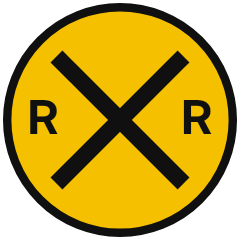
9. Where is this sign installed in relation to the hazard it announces?
Show answer
Answer A: Far enough before the hazard that a driver can slow down and stop short of it
This is an advance warning sign, placed on the approach so a driver has time to react before reaching a crossing that a curve or a crest may be hiding.
-
10. Should you drive with your hazard lights flashing while moving in fog?
Show answer
Answer A: No, they hide your turn signals and suggest you are stopped
Hazard lights on a moving vehicle tell other drivers you are stopped or disabled, and they cancel out your turn signals just when clarity matters most.
-
11. At a rural intersection a beacon flashes yellow toward the main road and red toward the side road. How is each approach treated?
Show answer
Answer A: The main road slows and proceeds, the side road stops
An intersection control beacon assigns flashing yellow to the road with priority and flashing red to the approach that must stop and yield.
-
12. What does Maine require when you meet an emergency vehicle stopped on the roadside?
Show answer
Answer B: Slow down and yield, moving to the next lane if it is possible to do so safely
Maine tells drivers to slow and yield the right of way, changing to the next lane when it is safe and otherwise passing slowly with caution.
-
13. Why do many crashes happen on routes the driver knows very well?
Show answer
Answer D: Familiar roads let attention slip into routine
When a route is automatic the mind wanders and hazards get missed, which is why a well known road deserves the same attention as a strange one.
-
14. How long do Maine's restrictions on a driver under 18 remain in force after the road test is passed?
Show answer
Answer B: 270 days, and a violation extends them another 270 days
The restrictions run for 270 days from the date the road test is passed, and violating them brings a suspension plus a further 270 day extension.
-
15. How long is the license suspension for a Maine OUI conviction with one prior conviction within 10 years?
Show answer
Answer C: 3 years
Maine imposes a 3 year suspension on a second OUI conviction within 10 years, along with a minimum fine of 700 dollars and 7 days of imprisonment.
-
16. A yellow sign ahead of an underpass reads LOW CLEARANCE 12 FT 6 IN. What does the figure tell you?
Show answer
Answer B: The greatest height that can pass beneath the structure
The figure is the actual clearance available, so a vehicle taller than that must leave the road and take a marked alternative route.
-
17. What do zero tolerance laws mean for a driver who is under 21?
Show answer
Answer B: They commit a violation at an alcohol level far below the adult limit
Drivers under 21 may not legally drink, so every state sets a limit far below the adult one and treats even a trace reading as a violation. The exact figure is set by each state, and the penalty usually includes losing the license.
-
18. A separate right-turn lane leads onto the cross street and carries a yield sign. What does it require?
Show answer
Answer D: Slowing and giving way to traffic and people, stopping if needed
A yield requires you to slow, give way to traffic in the lane you are joining and to pedestrians, and stop only if that is what safety demands.
-
19. You are turning right from a one-way street onto a two-way street. Where should the turn end?
Show answer
Answer A: In the lane nearest the right curb of the street you are entering
A right turn starts and finishes as close to the right as practical, so you leave the one-way street from the right lane and arrive in the lane nearest the right curb.
-
20. Which Maine drivers may use a telephone in hands-free mode?
Show answer
Answer D: Drivers 18 or older who hold neither an intermediate license nor a learner's permit
Maine's handheld ban leaves hands-free use open to drivers 18 or older who do not hold an intermediate license or a learner's permit.
-
21. What does Maine require of a licensee stopped by a law enforcement officer while driving?
Show answer
Answer D: That the license be in immediate possession and produced on demand, on paper or electronically
Maine requires a licensee, including a temporary licensee or a permit holder, to have the license in immediate possession and to produce it on demand, and an electronic version on a portable device is accepted.
-
22. What does a tire with worn tread do on a wet road?
Show answer
Answer B: It loses grip and it hydroplanes at a lower speed than a good tire
Tread grooves carry water away from the contact patch, and a worn tire cannot do that, so it floats on the water sooner.
-
23. Where should the lap part of the seat belt sit?
Show answer
Answer C: Low and snug across the hips, touching the tops of both of the thighs
The hip bones can take crash forces, but the abdomen cannot, so the lap belt goes low and tight across the hips.
-
24. Before a Maine applicant under 21 may take the road test, how much practice driving is required?
Show answer
Answer A: 70 hours, including 10 hours of night driving, after holding the permit 6 months
Maine requires the permit to be held 6 months and a certified minimum of 70 hours of driving, of which 10 hours must be at night.
-
25. You have just driven through a deep puddle and your brakes feel weak. What should you do?
Show answer
Answer D: Drive slowly while lightly applying the brakes until they dry and work normally
Wet brakes grip poorly and may pull to one side. Gentle braking at low speed generates heat that dries the pads and discs quickly.
-
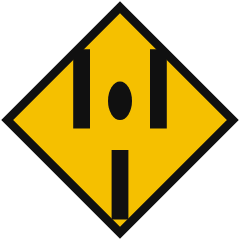
26. What must a driver be ready for beyond this sign?
Show answer
Answer C: Vehicles approaching from the opposite direction in the next lane over
The separation between the two directions runs out, so from that point oncoming vehicles share the same pavement and the driver has to keep right.
-
27. A regulatory message is normally carried on a sign whose shape is
Show answer
Answer A: a rectangle standing taller than it is wide
Regulatory signs that state a law, such as speed limits and turn restrictions, use a vertical rectangle with a black legend on a white background.
-
28. Lights set into the pavement along both edges of a crosswalk start to flash yellow as you approach. What do they tell you?
Show answer
Answer D: Someone is crossing and has to be given way
In-roadway warning lights flash only when a pedestrian activates the crossing, so a flashing pattern means somebody is in or entering the crosswalk.
-
29. Which Maine applicant under 18 does not have to present a driver education certificate?
Show answer
Answer A: One who is applying only for authority to operate a moped
Maine requires a certificate of completion of an approved driver education course from every applicant under 18, and the only operation excepted is that of a moped.
-
30. You are waiting to turn left and a motorcycle is approaching from the opposite direction. Why should you take extra care judging its speed and distance?
Show answer
Answer A: Its small size makes it look farther away and slower than it really is
A motorcycle's narrow profile fools the eye, so drivers often misjudge how soon it will arrive. Left turns across an oncoming motorcycle are a leading cause of rider deaths.